Someone answers at 2 a.m.
Carey is the AI assistant inside the FAM AI Connect experience: patient, easy to understand, and designed to bring family communication, daily routines, and approved services into one familiar conversation as integrations become available.
People keep trying to sell a tablet, an app, or an hour of someone's time.
Carey is none of those, so it needed a name. Two of them, actually — one for what it is, one for how it's bought.
A companion — not a menu — reachable on the phone a person already carries, every hour of every day, in their own language.
Bought per participant, per month. No dedicated hardware inventory, shipping, repairs, or depreciation.
Hardware is a tax on care
A purpose-built device costs $299 before anyone says hello, then has to be shipped, charged, repaired, replaced, and eventually recycled. Carey ships as a phone number.
Nothing to open, nothing to learn
There is no home screen to navigate and no password to remember. Carey calls her. Or she says one phrase. Talking is the entire interface.
It doesn't replace hands
An aide cooks, drives, and helps with a shower. Carey can't. Carey covers the other 124 hours a week when nobody is scheduled.
“She won’t use it.”
We designed Carey around that sentence.
Every senior-tech purchase dies in the same drawer. Here is exactly why this one doesn't.
No new device
It's the phone she already answers when you call. Same ringtone, same screen, same everything.
No app to open
Carey calls at the time she picked. In between, one phrase reaches her — no icon hunting.
No typing, no menus
No passwords, no updates, no settings screens. She speaks; Carey answers.
She sets up nothing
You do it, remotely, in about four minutes. Then Carey asks her permission before it begins.
Her first language is where her memory lives.
By the eighth decade, comfort, humor, prayer and recall all sit in the language a person grew up inside — often after the second language starts to tire. Carey works there. And here is the part no staffing model can copy:
The day happens in Tagalog. The summary arrives in English.
Rosa talks to Carey in a supported language. At 7:45 her daughter Marisol gets the day in the language she works in. This illustrates the intended caregiver bridge; each language pair must be validated before production use.
See supported locales and roadmapSwitches mid-sentence
Her sister calls and they fall into Tagalog halfway through a thought. Carey follows in under half a second. Nothing is set, nothing is opened.
Right-to-left, properly
Arabic reads right to left, and so does Carey — in the demo on this site, not just in a spec sheet.
One conversation. The services of daily life, brought together.
Carey is being designed to understand an ordinary request, ask for confirmation when an action matters, and hand the task to an approved service. Families keep one familiar conversation instead of teaching someone another collection of apps.
Comfort and safety
Planned connections for compatible lights, thermostats, locks, pathway lighting, and household safety sensors.
Calls without the app hunt
Planned voice and video handoffs for family, care coordinators, and approved enterprise phone systems.
Rides in plain language
Planned connections for approved rideshare, paratransit, and non-emergency transportation programs.
Refills, groceries, and meals
Planned connections for participating pharmacies, delivery providers, and community meal programs.
Signals families can understand
Planned, permission-based connections for compatible wearables, activity trends, and caregiver check-in workflows.
Carey asks. The approved provider acts.
Availability will vary by plan, provider, device, location, and participant permission. Emergency services, medical advice, and guaranteed third-party fulfillment are not represented by this roadmap.
Roadmap notice: named service categories describe intended interoperability, not current availability or endorsement. Third-party accounts, equipment, eligibility, fees, and terms may apply.
Start at the top of the ladder.
Per year at 44 hours a week — the national average for homemaker services at $33.99/hour. Covers 26% of the week.
Genworth / CareScout 2025 Cost of Care SurveyFirst year: a $299 proprietary tablet plus $40/month service. Then $480/year. A real product — and a device that has to arrive, charge, and survive.
Consumer Cellular pricing via SeniorLiving.org, 2026Illustrative Core pricing starts at $29.99/month. Premier is expected at $39.99–$49.99/month as connected services become available.
Illustrative pricing · third-party fees may apply · subject to final termsWhich one are you?
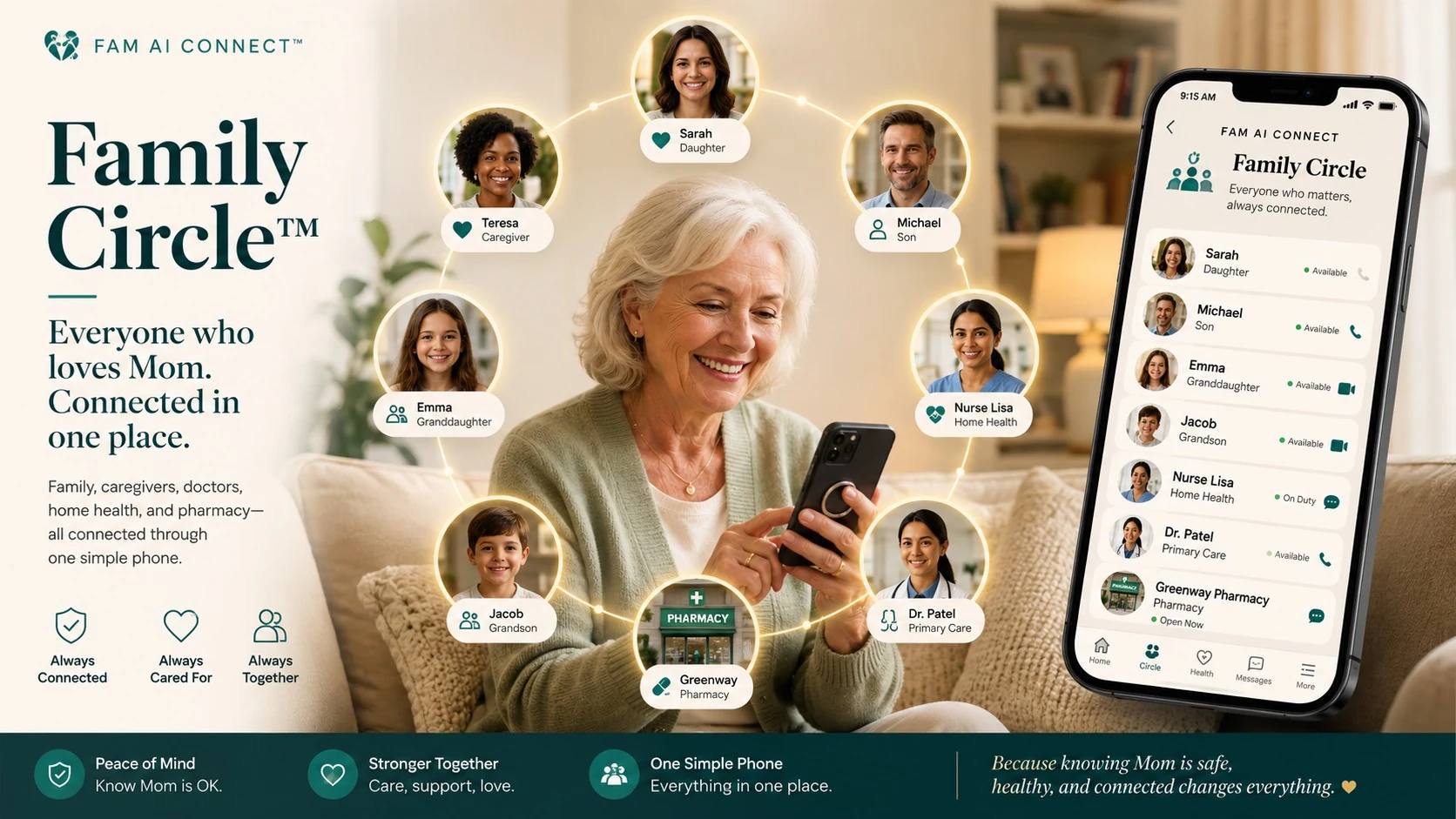
I'm here for myself or someone I love
Preview a plan, registration path, and accessible profile. If you help someone else, Carey still waits for their yes.
Preview setup →I want to distribute Carey
Same channel GrandPad proved. Same participants. Zero inventory. Connected-services wholesale is projected from $9/participant/month, subject to volume and final agreement.
See licensing and margins →A day with Carey, start to finish.
Eight moments show the intended experience in order. Change the language at any point and the same day re-runs in it. Rosa is a composite scenario; the dialogue and capabilities shown are illustrative.
Language shouldn’t be a barrier—it should be a bridge.
For millions of families, love is spoken in a language other than English. When it comes to caring for an aging parent, language shouldn’t stand between them and the people who care.
For a companion like Carey, speaking a senior’s native tongue isn’t just a feature on a spec sheet; it is the foundation of trust. If Carey doesn’t speak the language a person dreams in, prays in, and laughs in, it can’t truly provide comfort. Here is how Carey brings families closer, no matter what language they speak.
Conversations that flow naturally
People don’t use menus to switch languages at the dinner table, and neither does Carey. Carey listens and adapts. If a thought starts in English and finishes in Spanish, Carey is designed to follow along and respond with the same warmth and cadence.
Bridging the family gap
A parent and caregiver never have to use the same language. A senior’s day with Carey can happen in Tagalog while the evening summary arrives on their daughter’s phone in English. No one has to translate, and care organizations can communicate without relying on a bilingual coordinator for every check-in.
Designed for every alphabet
Carey’s interface and daily summaries are designed to read clearly and naturally in each supported language. That includes the right-to-left layouts required for scripts such as Arabic, Hebrew, Farsi, and Urdu as those languages complete validation.
Two generations. Two languages. One circle of care.
Here is how Carey keeps everyone in the loop at 7:45 PM:
“Magandang gabi, Rosa. Naalala mo bang tumawag si Elena? Apatnapung minuto kayong nag-usap. Matulog ka nang maaga ngayon.”
“Rosa had a peaceful day. She was awake briefly at 2:10 AM but took both her medications. A spam caller reached her at 3:00 PM, but she hung up safely. She also enjoyed a 40-minute chat with Elena, and asked about Miguel twice.”
One day. One circle of care. No interpreters, no delays.
Four fluent languages today, with many more on the roadmap.
Carey is currently fluent in four core languages, with a deep commitment to learning many more. Each new language undergoes rigorous testing for conversational warmth, cultural nuance, and accessibility before it is introduced to families.
Fluent today
On our roadmap
We are actively teaching Carey to support the following languages and regional variants:
Additional languages and regional variants can be added upon request from licensed distributors. Roadmap availability is not a contractual guarantee.
The competition isn’t a tablet. It’s the hour nobody covers.
Here is the honest version, with every competitor figure sourced and dated. Carey's own pricing is illustrative until final terms are published.
| Carey | GrandPad | In-home companion aide | No solution | |
|---|---|---|---|---|
| Device required | None — her existing phone | Proprietary 8″ tablet, $299 | — | — |
| Hours covered per week | 168 | Device only | 8 – 44 | 0 |
| Speaks the participant’s first language | 4 validated mobile locales; additional languages on the roadmap | Interface language only | Only if you can staff it | — |
| Caregiver reads the summary in their language | Yes, automatically | No | No | No |
| Answers at 2:10 a.m. | Yes | No | Rarely, at overnight rates | No |
| Calls out sick, quits, gets reassigned | Never | — | Turnover is a known operating risk | — |
| Shipping, charging, repair, replacement | None | Operator-borne | — | — |
| Time from decision to first conversation | Minutes | Days — it has to ship | Weeks — intake and matching | — |
| Year-one cost | $359.88 – $599.88 | ~$779 | ~$35,350 – $77,769 | $0 and the whole risk |
Sources — Aide: Genworth & CareScout 2025 Cost of Care Survey, national average $33.99/hr for homemaker services, $77,769/yr at 44 hrs/wk; 20 hrs/wk figure derived at the same rate. GrandPad: Consumer Cellular pricing reported by SeniorLiving.org, 2026 — $299 device (or ≈$12/mo financed over 24 months with $11 down) plus $40/mo service, $38/mo for AARP members; some third-party channels reported at $65/mo. Carey: illustrative.
Move the sliders. The argument makes itself.
Aide figure = hours × 52 × $33.99 × people. GrandPad = ($299 + $40 × 12) × people. Carey Core = $29.99 × 12 × people, before distributor or volume pricing. Carey pricing is illustrative.
What Carey cannot do.
If you are evaluating this for an agency or a health plan, you already know a one-sided comparison is a warning sign. So:
- Carey has no hands. It cannot cook, bathe, lift, drive, change a dressing, or notice that the stove is on. An aide does all of that and Carey does none of it.
- Carey is not a medical device. It gives no medical advice, makes no diagnosis, and is not a substitute for a clinician or for 911.
- Carey is not a PERS. It is not a fall detector or an emergency response system, and should not be sold as one.
- Some people should have a GrandPad instead. If someone cannot or will not use a phone, a purpose-built device with a curated contact list and a hardware support line is genuinely the better product. GrandPad built that well.
- Carey needs a phone and a signal. No connection, no companion.
Same channel. Same participants. Zero inventory.
GrandPad proved that agencies, Area Agencies on Aging, health plans and telecom resellers will put a companion product into older adults' hands at scale. Their distributors carry tablets — inventory, freight, breakage, returns, refurbishment, depreciation. Carey's distributors carry a spreadsheet.
Territory license and wholesale tiers.
Founding cohort terms. County-level exclusivity available at Regional and above.
Founding Distributor License — $2,500
Waived entirely at 100+ activations in your first 90 days.
Renewal — $995
Waived above 250 active seats. No renewal in year one.
White-label / co-brand — $500/mo
Your name, your voice persona, your summary template.
| Tier | Active seats | Wholesale | Suggested retail | Margin / seat | Monthly margin at tier floor |
|---|---|---|---|---|---|
| Starter | 1 – 99 | $18 | $34.99 – $39.99 | $16.99 – $21.99 | $1,682 at 99 |
| Growth | 100 – 499 | $15 | $34.99 | $19.99 | $1,999 at 100 |
| Regional | 500 – 1,999 | $12 | $29.99 – $34.99 | $17.99 – $22.99 | $8,995 at 500 |
| Enterprise / Statewide | 2,000+ | $9 – $10 | Custom enterprise | Volume contract | Contract-based |
All figures are illustrative projections and subject to final distributor agreement. Retail price is a suggestion, not a requirement. Margins shown are retail less wholesale and exclude taxes, payment processing, refunds, staffing, and any provider pass-through charges.
How long until the license pays for itself?
Projected payback is measured against the $2,500 founding license, before the 100-activation waiver. It excludes acquisition, staffing, taxes, payment processing, refunds, and provider pass-through charges.
If you already reach older adults, you already have the channel.
Care and community
Home-care agencies · Area Agencies on Aging · Medicaid HCBS waiver providers · PACE programs · hospice and palliative organizations · faith and community organizations
Payers and operators
Medicare Advantage plans using supplemental benefit and SSBCI budgets · senior living and CCRC operators · care-management and case-management firms
Commercial
Telecom and senior-tech resellers · pharmacy and DME channels · independent entrepreneurs building a book of business in one county
A controlled handoff portal
Request server-issued setup codes, see activation status, and track seats. Participant profile choices stay with the participant or an authenticated representative.
Participant support, handled
Carey answers the participant's support calls. Not you. This is the single largest hidden cost in hardware distribution and it is not yours.
Territory protection
County-level exclusivity at Regional tier and above, with a stated activation floor to keep it. Territories are finite; that scarcity is structural, not a countdown clock.
Distributor registration.
Preview the information used to start verification. A production account opens only after identity, agreement, territory, and billing checks succeed.
The eight questions you're actually going to ask.
Who takes the participant's support calls?
The planned service model routes Carey support through FAM AI Connect rather than the distributor. Hours, supported locales, response targets, and escalation terms will be defined in the production agreement.
How does billing work?
You are invoiced monthly for active seats at your tier rate. You bill your participants or your payer however you like, at whatever price you set. Seats added mid-month are prorated; seats cancelled stop billing at the end of that month.
What happens to churn?
Cancellations reduce your active seat count and can move you down a tier at the next monthly boundary. There is no penalty and no minimum-purchase clawback — you carry no inventory, so there is nothing to be stuck with.
What if two distributors want the same county?
Exclusivity is granted at Regional tier and above, first qualified applicant, and is held by meeting a stated activation floor. Below that tier, territories are non-exclusive and openly overlapping — we tell you which before you sign, not after.
Who owns the participant relationship and the data?
The participant owns their conversations. You receive operational summaries — activation, engagement, adherence prompts, escalation events — only where the participant has consented. If a participant leaves your book of business, their Carey account and history go with them.
What happens when a participant needs real help?
Carey escalates to the care circle by the rules you configure, and instructs the participant to call 911 in an emergency. Carey does not dispatch emergency services, does not diagnose, and does not replace a PERS device. Escalation reporting is planned for eligible Carey Premier seats.
How do I get out?
Thirty days' written notice, no exit fee. Participants may keep their Carey accounts and convert to direct retail; you are not required to transition them and they are not stranded.
What does white-label actually change?
Your brand, your assistant's name and voice persona, your daily summary template and sender identity, and your URL. It does not change the underlying service, the languages, or the support path.
Next tier
Give the participant a safe way in.
A distributor can request a setup code or approved link. The distributor cannot choose authority, consent, identity, or participant profile settings.
Create demonstration handoffs
What a distributor never authors
- Participant identity, legal authority, or consent records
- Emergency or clinic routing and immutable system controls
- Participant preferences or a caregiver’s role
- A hardware-bound session or device enrollment token
Demonstration setup codes
These examples begin with DEMO and are intentionally unusable. Production values must come from the signed-in server session.
| Handoff | Channel | Created | Expires | Status |
|---|
What must happen before a real handoff.
- Verify the organization and signer. The browser never grants distributor authority.
- Complete agreement and billing. Pricing and territory become binding only in signed documents.
- Sign in to the protected portal. The backend resolves role and permitted operations from the session.
- Request a setup handoff. The participant or authenticated representative redeems it and completes provisioning.
Contract v1.4.0: the production portal validates every write server-side, binds requests to an authenticated session, and never treats a distributor-selected role as authority.
One clear path from purchase to a ready profile.
Preview how purchase, registration, and accessible setup will work once the authenticated commerce and provisioning services are connected.
How is Carey being provided?
Who is completing this setup?
This choice changes the preview only. In production, the signed-in session—not this button—determines authority and writable fields.
Participant profile preview
Controls below mirror the Carey participant profile contract v1.4.0. Server-owned identity, authority, consent, lifecycle, and protected routing are intentionally absent.
- Verified participant identity and authority from the server
- Hardware-bound session and one-time setup-code redemption
- Schema validation, CSRF protection, and version conflict checks
- Participant review, consent, refusal, correction, and caregiver handoff